In brief: With ten days until the November 3 election, Democrats hold a clear national lead, but the Senate comes down to seven toss-ups. Texas and Maine are tied in the latest Fox News polls, and Ohio, Michigan, Iowa, Kansas and Alaska are all close. On October 23, the Justice Department sued to block Alaska from certifying its Senate result if Sen. Dan Sullivan narrowly loses, and President Trump said, “I’m the one that said ‘do it.’” A lawsuit filed before a single vote is counted signals what happens if the voters’ answer is wrong.
Where does the national race stand?
This is our third roundup, after four weeks out and nineteen days out. The national picture has not improved for Republicans. A New York Times/Siena poll of 3,494 likely voters, taken October 12–19, found 52% planning to back the Democratic House candidate and 41% the Republican, Fox News reported. The ABC News/Washington Post/Ipsos poll put Mr. Trump’s approval at 33%, the lowest of either term in that survey, and NBC News and Fox News also found record or second-term lows.
Voters are not waiting. Georgia set a record on the first day of early voting, October 14, with 188,667 in-person ballots, about 40% more than the first day of 2022.
Which Senate races will decide control?
The Cook Political Report’s October 20 ratings list seven toss-ups: Alaska, Iowa, Kansas, Maine, Michigan, Ohio and Texas. Republicans hold six; only Michigan is a Democratic seat. Here is where they stand:
- Texas (open, R-held). A Fox News poll of 1,398 likely voters (October 15–19) has James Talarico and Ken Paxton tied at 49%. Talarico led 51% to 49% in September. Elon Musk has urged Texans to vote for Paxton.
- Maine (Collins, R). Fox News (October 16–20) has Sen. Susan Collins and Troy Jackson tied at 49%. Collins has survived close races before; this may be her hardest.
- Ohio (Husted, R). Fox News (October 15–19) has former Sen. Sherrod Brown ahead of Sen. Jon Husted, 52% to 47%, in a state where Mr. Trump’s approval is 43%.
- Michigan (open, D-held). Marist (October 15–18) has Democrat Abdul El-Sayed ahead of Mike Rogers 50% to 48% among likely voters, well within the margin of error. A pro-Trump super PAC has spent $25 million for Rogers.
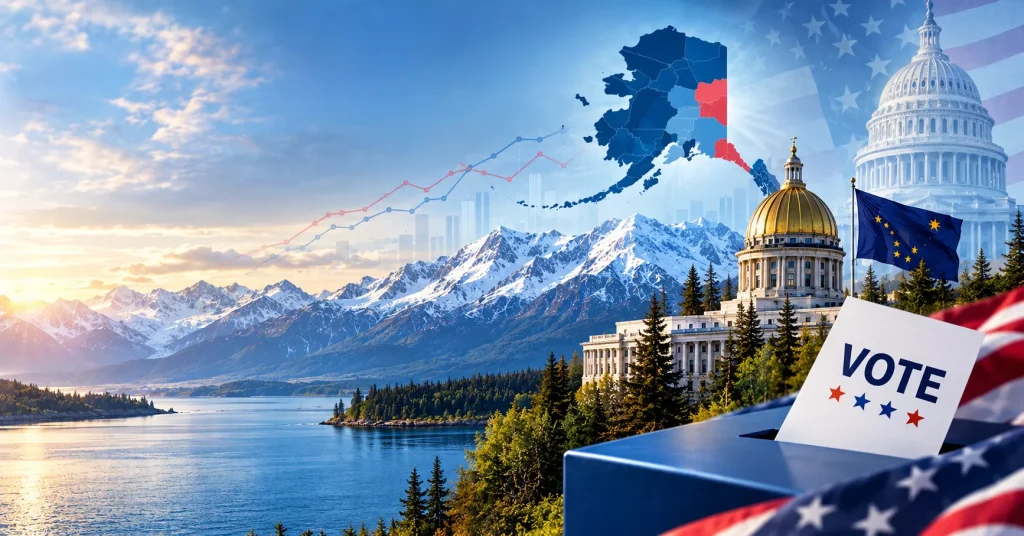
- Alaska (Sullivan, R). FiftyPlusOne’s average shows former Rep. Mary Peltola about two points ahead of Sen. Sullivan, CNBC reported. More on this race below.
- Iowa (open, R-held) and Kansas (Marshall, R). Both are within the margin of error. Democrat Josh Turek and Rep. Ashley Hinson are running for an open seat in Iowa; in Kansas, Sen. Roger Marshall and Democrat Adam Hamilton debated on October 21.
Beyond the toss-ups, Cook rates New Hampshire and Minnesota Lean Democratic, Georgia and North Carolina Likely Democratic, and South Carolina Lean Republican. Democrats are even spending in Mississippi, rated Likely Republican.
What is the Justice Department doing in Alaska?
On Thursday, October 22, the department filed suit in federal court in Alaska asking a judge to bar the state from certifying “any result that may be impacted by voter confusion,” pending an investigation into whether votes cast for a second candidate, retired teacher Daniel J. Sullivan, “were meant to be cast for Senator Sullivan,” according to CNBC. The suit does not explain how anyone could determine a voter’s intent on a secret ballot.
The concern isn’t new. Alaska’s own Division of Elections originally kept Daniel J. Sullivan off the primary ballot, finding his candidacy was aimed at misleading voters, before state courts put him back on. He received 2.5% in the August primary. Alaska uses ranked-choice voting, and the department argues some of the senator’s supporters may rank the wrong Sullivan. Daniel J. Sullivan has said he is running because he is unhappy with the incumbent’s record.
What is extraordinary is the remedy, and the timing. Hours before the filing, Mr. Trump called the second candidacy a “SCAM” on Truth Social, writing that “even 1, 2, or 3% could make the difference.” On October 23, he told reporters, “I’m the one that said ‘do it.’” Before the filing, Attorney General Todd Blanche had told reporters the department had no plans to “improperly interfere” with certification. Sen. Sullivan’s campaign said, “We’ll let the DOJ complaint run its course.” Peltola’s campaign called it “a despicable political threat to overturn an election.”
Why does a lawsuit before the vote matter so much?
It frames a loss as theft in advance. Democracy depends on what political scientists call “losers’ consent”: the losing side accepts the result and tries again next time. A suit that asks to freeze one outcome, and only that outcome, tells supporters in advance that a loss would not be legitimate.
Rhetoric changes what people believe. In a 2021 PNAS Study, political scientists including Brendan Nyhan and Ethan Porter found that exposure to Mr. Trump’s claims that the 2020 election was illegitimate lowered people’s confidence in elections and, among his supporters, increased belief that it was rigged. A leader’s words shape what followers expect to see.
It fits a pattern. Mr. Trump governs as an authoritarian, or at least leans that way. This month alone, the administration has sued California over alleged noncitizen voters and pressed states to purge their rolls; Senate Democratic leader Chuck Schumer and House Democratic leader Hakeem Jeffries have sued to stop federal officials from removing voters from state lists. Each step has a stated justification. Together, they suggest a federal government determined to influence elections the Constitution largely leaves to the states.
Supporters see something else. To many of the president’s voters, Daniel J. Sullivan’s candidacy looks like a dirty trick, and a president who fights it looks like someone protecting their vote. He projects strength. For them, the belief is the reality.
Can we trust the polls?
Mostly, but read them carefully. On October 20, a little-known firm, Wedgewood Polling, admitted that most of its releases this year used fabricated numbers, calling it an “experimental project.” The New York Times removed 15 of its polls from its averages. (Our nineteen-days-out roundup cited a Wedgewood survey of Mississippi; we have removed it.)
The lesson is not that polls are worthless. The established pollsters cited here, including Fox News, Marist, and the Times and Siena, disclose their methods, sample sizes, and margins of error. The lesson is to trust averages over single surveys and to treat a two-point lead as a tie. As Rep. Mallory McMorrow, whose campaign was hurt by a fake poll, put it: “Don’t get complacent and don’t trust the polls.”
What should voters watch in the final ten days?
Turnout, not toplines. In races this close, the winner is whoever gets supporters to show up. Record early voting suggests an energized electorate, though it does not say for whom.
Anxiety cuts both ways. Fear of losing motivates some people to vote and leads others to tune out. In Marist’s Michigan poll, 44% of likely voters said they are voting mainly against Mr. Trump, and 18% said they are voting mainly for him. Opposition is a powerful motivator in a midterm.
A count takes time. Alaska typically runs its ranked-choice tally about two weeks after Election Day, and several states count mail ballots after Election Day. A slow count is not a sign of fraud. It means the system is counting every ballot. Patience, in the days after November 3, will be its own test of the country’s nerves.
Related commentary
- Nineteen Days Out: The Midterm Polls Are Shifting
- “Leakers Should Be Shot”: The Psychology of Intimidation
- The Psychology of Trump’s Supporters, 2016–2026
- Four Weeks Out: The Midterm Map
Sources
- DOJ sues Alaska to block Senate race certification if Republican loses — CNBC (Oct. 23, 2026)
- Trump told DOJ to sue to block Alaska Senate results — ABC News (Oct. 23, 2026)
- 2026 Senate race ratings (Oct. 20, 2026) — Cook Political Report
- Midterm elections live: Fox News polls in Ohio and Texas (Oct. 21, 2026) — Fox News
- Hottest 2026 midterm races (updated Oct. 23, 2026) — Forbes
- Midterm Elections in Michigan, October 2026 — Marist Poll
- Trump approval hits lows in Fox, NBC, Washington Post polls — Axios (Oct. 18, 2026)
- Georgians shatter first-day early voting record — Georgia Secretary of State
- Fake polling firm admits fabricated surveys — KUTV/The National Desk (Oct. 21, 2026)
- Clayton et al., Elite rhetoric can undermine democratic norms (PNAS, 2021) — Dartmouth