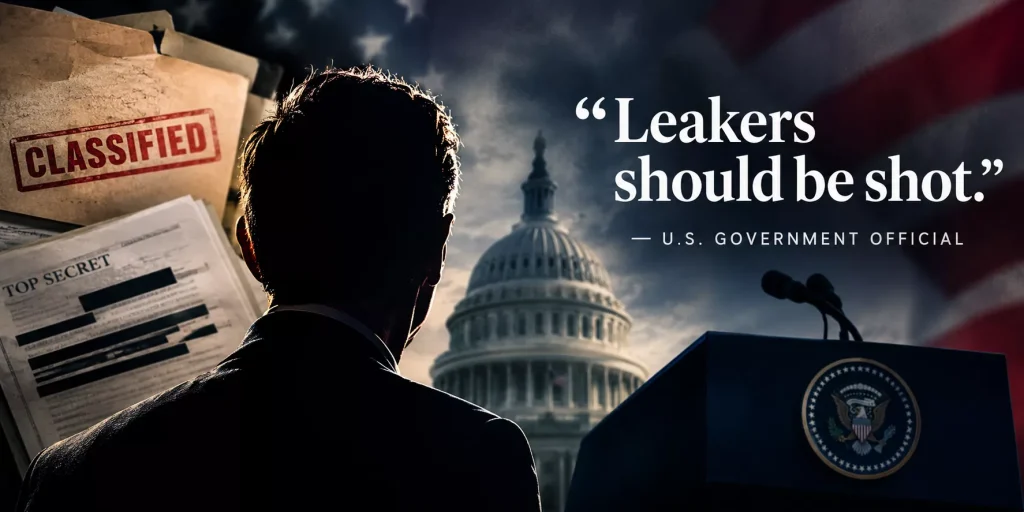
In brief: On October 14, President Trump told a rally in Bullhead City, Arizona, that “leakers should be shot,” then turned on the reporters covering him. The remark landed in a week when federal agents searched Rep. Ilhan Omar’s home, the Justice Department sued California over alleged noncitizen voters, and election offices received letters with white powder. Threats do not have to be carried out to work; their power lies in what people stop saying and doing out of fear.
What did President Trump say, and what else happened this week?
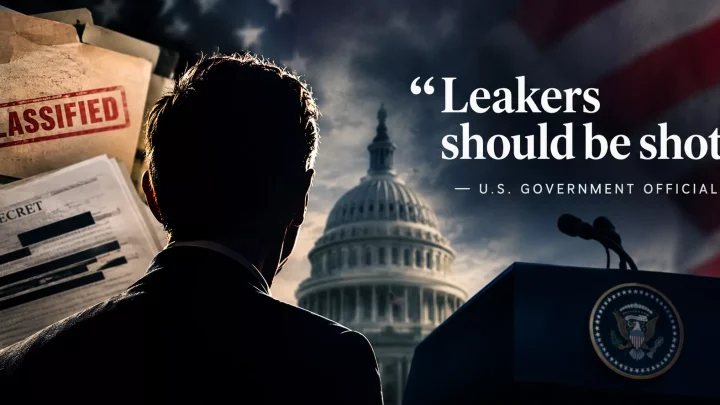
Speaking at Laughlin/Bullhead International Airport, Mr. Trump described a leak he said exposed the timing of a U.S. strike on Iran. “In my opinion, leakers should be shot,” he said. “In the old days, we used to shoot leakers.” He called leakers “the scum of the earth,” then pointed to the press area: “Those same people up there, they’re almost as bad as a leaker, because they leak.” He said leaks endanger troops; on Truth Social, he said those responsible “should be prosecuted.” Reports noted no White House comment on whether he meant it literally.
Two days earlier, on October 12, Homeland Security Investigations agents searched Rep. Omar’s Washington home under a court-authorized warrant. The Justice Department calls it an “ongoing federal criminal investigation.” Reports say it concerns whether she made false statements in her childhood immigration paperwork; she became a citizen in 2000. Agents seized her phone, laptop, and passport; relatives were subpoenaed, and, according to CNN, Magistrate Judge Matthew Sharbaugh limited the department’s access to her records before approving the warrant. Omar has not been charged, denies wrongdoing, and called the search “an attempt to target political enemies and weaponize federal law enforcement.” Mr. Trump said he had “nothing to do with it,” while calling her “totally crooked.” Even former Rep. Marjorie Taylor Greene, a longtime Omar critic, dismissed the probe, asking how “pretending to get ready to deport Ilhan Omar” would lower grocery bills.
Meanwhile, the Justice Department gave California officials 48 hours to review a list of alleged noncitizen voters, then sued to have their ballots set aside. The department says it is not seeking a “purge.” Secretary of State Shirley Weber said the effort serves “only to cause chaos and fuel public distrust.” In Nevada, a review of 185 people flagged by Homeland Security found all were citizens. And the FBI is investigating letters, some containing white powder, received by election officials in Louisiana, Oklahoma, and Wisconsin, with more intercepted elsewhere. No one has tied the letters to any official.
How do threats work if they are never carried out?
The chilling effect. A threat targets not only its intended victim but everyone watching. When people see that speaking up carries risk, many quietly decide not to. After the Snowden disclosures in 2013, researcher Jon Penney found that traffic to Wikipedia articles on terrorism-related topics fell nearly 30%. Nobody was punished for reading; the mere sense of being watched changed behavior.
Fear invites compliance. Fear narrows attention and pushes people toward safety. A government employee weighing whether to tell a reporter about wrongdoing, or a journalist weighing a story, now has a new, vivid image in mind. Most will never face real consequences, but they cannot know that in advance, and uncertainty is the point.
Self-censorship spreads. People who stay silent also deprive others of signals that it is safe to speak. Silence becomes the norm.
What is “stochastic terrorism,” and does it apply?
The term describes a pattern in which public figures demonize a person or group, and media-amplified rhetoric raises the statistical odds that some unknown individual will act violently, without a direct order. The speaker can always say it was a joke or a figure of speech. Critics, including free-speech advocates, argue the concept is loosely defined, hard to prove, and can be used to blame speakers for crimes others commit. That caution is fair. No one can say any specific act follows from any specific remark.
But the research on violent language is not reassuring. In experiments by political scientist Nathan Kalmoe, even mild combative words in campaign ads increased support for political violence among people high in aggression. Omar has lived the pattern: last January, hours after Mr. Trump criticized her, a man sprayed her with a vinegar-filled syringe at a town hall.
Why does extreme rhetoric stop shocking us?
Repetition normalizes. The first time a president says something like this, it is a scandal. By the tenth time, it is a headline that fades by lunch. Psychologists call this habituation.
The window shifts. Economists Leonardo Bursztyn and colleagues found that Mr. Trump’s 2016 rise made people more willing to express socially taboo views publicly, and less likely to be judged for doing so. When a leader says the unsayable, followers learn that the boundaries of acceptable speech have moved. Political scientists call that range the Overton window.
Why do supporters hear strength, not menace?
To many supporters, “should be shot” is hyperbole, the way people talk in anger, and a sign that he takes national security seriously. He projects strength. For voters who feel the government, the media and elites have lied to them for years, a leader who threatens leakers and scolds reporters looks like someone finally fighting for them. In PRRI’s May 1–18 survey, 78% of Republicans agreed that he is “a strong leader who should be given the power he needs,” even as 59% of all Americans called him “a dangerous dictator.” For his base, the belief is the reality. (See Trump Follower Psychology 101.)
This site argues that Mr. Trump governs as an authoritarian, or at least leans that way. This week’s record supports it: a president talking about shooting leakers and lumping reporters in with them, a criminal search of a prominent critic’s home 22 days before she faces voters, and pressure on a state to set aside ballots on a list its officials call unverified. Each has a stated justification. Together, they send a message about who can safely oppose him.
How does intimidation affect voters and election workers?
Election officials already feel it. In the Brennan Center’s survey of 834 local election officials, fielded January 27 to February 26, 2026, 32% reported being threatened, harassed, or abused because of their job, half worried about political leaders interfering in their work, and 45% feared politically motivated investigations. Gallup’s spring survey (April 24–June 10) found 52% of Americans concerned about voter intimidation near polling places.
Fear can cut both ways. Some people stay home; others turn out precisely because they feel threatened. Senate Democrats say they will send more than 100 staff observers to nine states. Meagan Wolfe, Wisconsin’s chief election administrator, responded defiantly: “This incident will not shake us.”
The psychology lesson: intimidation succeeds when people believe they are alone. It fails when they see others standing up. With 19 days until Election Day, the most powerful answer to fear is the ordinary act of showing up.
Related commentary
- Four Weeks Out: The Midterm Map
- The Psychology of Trump’s Supporters, 2016–2026
- Signs of Bullying
- Two Americans Dead, Nine Months Later
Sources
- Trump suggests those who leak government information should “be shot” — Al Jazeera (October 15, 2026)
- Trump tells Arizona rally leakers “should be shot,” then points at reporters — Eastern Herald
- US agents search home of Ilhan Omar — Al Jazeera (October 12, 2026)
- Judge limits DOJ access in Ilhan Omar investigation — iHeart (citing CNN)
- Trump says he had “nothing to do” with Omar raid — KATV
- MTG comes to Ilhan Omar’s defense — Mediaite (October 14, 2026)
- DOJ sues California over alleged noncitizens on voter rolls — ABC News (October 15, 2026)
- FBI says election officials targeted by suspicious letters — Votebeat (October 15, 2026)
- 2026 Local Election Officials Survey — Brennan Center
- Election concerns run high ahead of 2026 midterms — Gallup