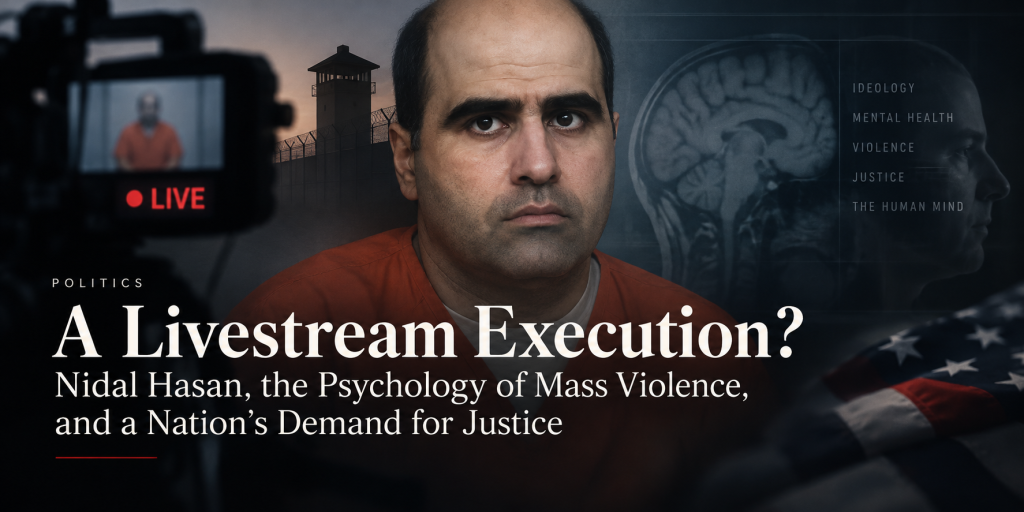
In brief: On October 15, President Trump called off the Pentagon’s plan to livestream the December 3 firing-squad execution of Nidal Hasan, who killed 13 people at Fort Hood in 2009. The reversal came a week after Defense Secretary Pete Hegseth announced the execution would be public, and hours after an ABC News/Washington Post/Ipsos poll found 80% of Americans opposed streaming it, even though a majority supported the execution itself. The episode shows where shock politics runs into deep human limits on watching violence.
What happened, and when?
On November 5, 2009, Nidal Hasan, then an Army major and psychiatrist, opened fire at a processing center at Fort Hood, Texas, where soldiers were preparing to deploy. He killed 13 people, 12 soldiers and one civilian employee, and wounded more than 30. Among the dead was Pvt. Francheska Velez, 21, who was pregnant. A military jury convicted Hasan and sentenced him to death in 2013.
On October 8, Mr. Hegseth said of the coming execution, “we’ll make sure that people can watch it, that it’s public,” and the Pentagon confirmed it would be livestreamed. It is set for 1 p.m. Central on December 3 at Fort Hood, the hour of the attack, according to Al Jazeera. It would be the first U.S. military execution since 1961 and the first by military firing squad since World War II.
Condemnation was swift and bipartisan. Sen. Thom Tillis (R-N.C.) called the plan “beyond disgusting”; Sen. Mark Kelly (D-Ariz.) said public executions are what Iran and the Taliban do. House Speaker Mike Johnson warned the video could become “a recruiting tool for future terrorists.” The UN human rights office said streaming it would breach “the absolute prohibition of torture,” and the president of the U.S. Conference of Catholic Bishops called it a “barbaric promotion of a culture of death,” AFP reported.
Mr. Trump first said he “absolutely” approved, then on October 9 sounded unsure: “I really don’t care how he goes, as long as he goes.” Axios reported he privately expressed doubts after heavy negative feedback. On October 15, he wrote on Truth Social that Hasan “will die, as scheduled, by firing squad, but this event will not be streamed,” adding that streaming “might have been a strong deterrent” but that “many very good and well-meaning people would rather not watch him die.” Victims’ immediate families may attend in person. As of today, the execution remains scheduled, though Hasan can still seek a delay in civilian court.
Why would leaders stage punishment as a spectacle?
The deterrence claim. The stated rationale was deterrence: Mr. Hegseth said people “need to understand that there are serious consequences.” But the evidence does not support it. In 2012, the National Research Council concluded that research on whether the death penalty affects homicide “is not informative” and should not be used to inform policy. For a man whose own court-appointed lawyers worried he was seeking execution, a broadcast could do the opposite of deterring, which is exactly what Speaker Johnson and others feared.
Strength signaling. Spectacle is about the audience, not the condemned. A televised firing squad says: this government is not squeamish, and it will show you what it does to enemies. That fits a pattern in which Mr. Trump governs as an authoritarian, or at least leans that way: describing an enemy as “SCUM,” personally claiming the final word on how a sentence is carried out, and an administration willing to borrow a practice the U.S. has long condemned abroad. Amnesty International counted at least 17 public executions in 2025 in Afghanistan and Iran.
Why supporters liked it: Many supporters see none of that. They see a mass murderer who waited 13 years for a sentence to be carried out, and a leader who finally refuses to be timid. Pastor Robert Jeffress backed the public execution, citing Genesis 9:6. In a 2002 study, researchers Kevin Carlsmith, John Darley, and Paul Robinson found that ordinary people punish mainly out of a sense of “just deserts” rather than deterrence; the punishment should match the crime. To these supporters, the plan projected strength. For them, the belief is the reality: the image of a fighter who will not apologize for justice.
Why did most Americans recoil?
The numbers. The ABC News/Washington Post/Ipsos poll, taken October 9–13 among 2,545 adults, found 53% supported executing Hasan by firing squad, but only 18% wanted it livestreamed; 80% did not. Time reported opposition at 91% among Democrats, 83% among independents, and 64% among Republicans. An Economist/YouGov poll taken October 10–12 found 69% opposed broadcasting executions, including 55% of death penalty supporters.
Disgust and dignity. Supporting a punishment and wanting to watch it are different things. Most people hold a strong intuition that even the guilty die with some privacy, and that killing turned into content degrades the viewer. Watching someone die triggers a disgust response that has nothing to do with sympathy for the condemned.
The harm to viewers. Exposure to violent images is not harmless. A 2014 study in PNAS by Alison Holman, Dana Rose Garfin, and Roxane Cohen Silver found that people who consumed six or more hours a day of Boston Marathon bombing coverage reported higher acute stress than people directly exposed to the bombings (the study shows an association, not proof of cause). A livestream would not stay on one site; clips would circulate for years.
Children and survivors. Retired Sgt. Alonzo Lunsford, shot seven times that day, plans to attend the execution, yet opposed the stream: “I don’t want kids to see it… it’s not entertainment.” For families, a public stream would turn a private reckoning into a national show and keep their worst day in circulation.
Why did America stop public executions in the first place?
The last public execution in the United States was the hanging of Rainey Bethea, a young Black man, in Owensboro, Kentucky, on August 14, 1936. An estimated 20,000 people attended, and journalists dubbed it a “picnic hanging.” Most states had already banned public hangings; Kentucky changed its law in 1938. That era taught us that public executions did not teach solemnity. They drew crowds, were bound up with racial cruelty, and turned death into entertainment, the same worry Charles Dickens raised about public hangings in England in 1849.
What does the 80% say about the limits of shock politics?
Shock works when it dramatizes something people already feel. Most Americans want Hasan to face justice; that was never in doubt. The plan failed because it asked them to become spectators, and most refused. When a coalition as broad as Speaker Johnson, Sen. Kelly, Tucker Carlson, and the Catholic bishops lines up against an idea, it has crossed from provocation into a violation of shared norms. Mr. Trump’s quick retreat, coming hours after the poll’s release, suggests he read the line too.
What are the benefits and drawbacks?
The benefit of the reversal is plain: the 13 victims are remembered as people, not as backdrop to a broadcast, and families who want to witness the sentence can do so with dignity. Supporters can fairly say the administration still delivered on its core promise of justice.
The drawback is that the idea was floated at all. Each time a government tests whether citizens will accept a spectacle of state violence, the boundary of the acceptable moves, even if the test fails. Political psychology teaches that norms erode with repetition. This time, 8 in 10 Americans held the line.
Related commentary
- Trump Follower Psychology 101
- The Psychology of Trump’s Supporters, 2016–2026
- How 9/11 Changed the American Psyche
- Two Americans Dead, Nine Months Later
Sources
- Trump says Fort Hood shooter Nidal Hasan’s execution won’t be livestreamed — Fox News (Oct. 15, 2026)
- Trump cancels livestream of Fort Hood firing squad execution amid bipartisan pushback — Time (Oct. 15, 2026)
- ABC News/Washington Post/Ipsos poll topline, Oct. 9–13, 2026 — Ipsos
- Trump cancels Hegseth’s plan to livestream Fort Hood shooter’s execution — Axios (Oct. 15, 2026)
- Trump sows doubt on plan to livestream U.S. military execution — AFP via ARY News (Oct. 10, 2026)
- Trump says Fort Hood shooter execution will not be livestreamed — Al Jazeera (Oct. 15, 2026)
- Johnson says not everyone in GOP is on board with Hasan execution livestream — Scripps News (Oct. 13, 2026)
- Fort Hood survivor Alonzo Lunsford on the execution livestream — theGrio (Oct. 10, 2026)
- 20,000 people watched a Black man hang in Kentucky 90 years ago — WPLN
- Holman, Garfin & Silver, Media’s role in broadcasting acute stress following the Boston Marathon bombings — PNAS