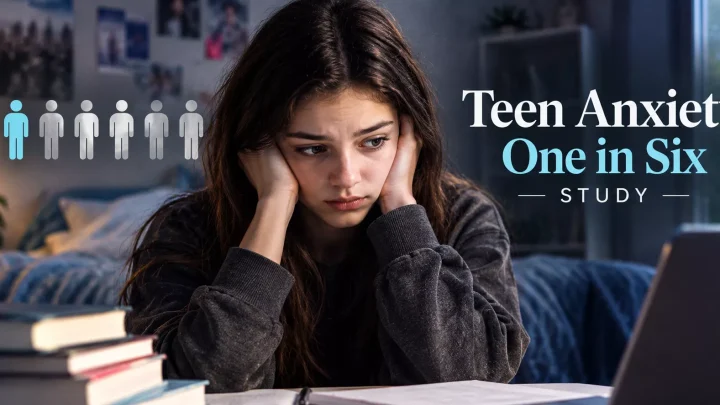
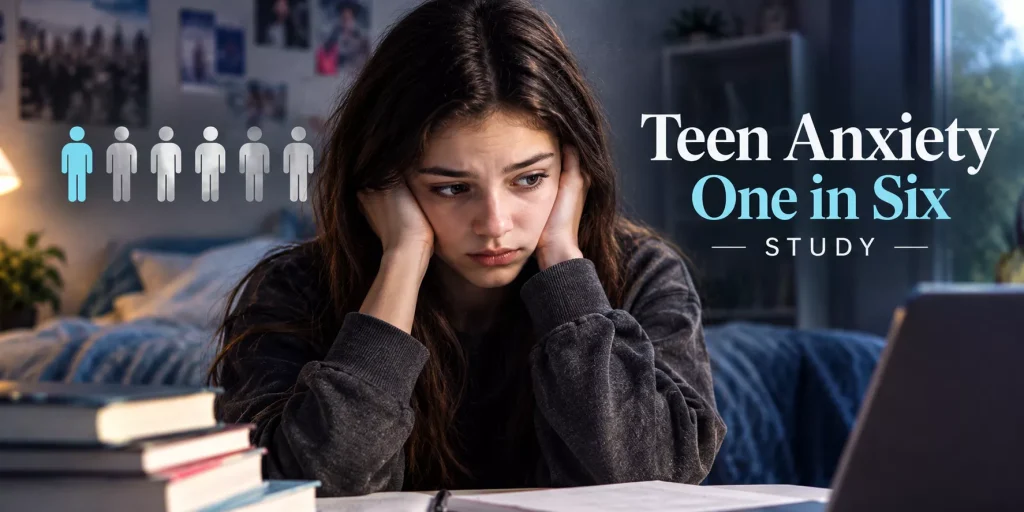
In brief: A national study published October 12 in JAMA Pediatrics found that about one in six Americans ages 12 to 20 report moderate to severe anxiety symptoms. Girls reported severe symptoms far more often than boys (about 11% versus 4%), and about 4 in 10 teens with severe symptoms received no mental health treatment in the past year. Worry is a normal part of growing up; anxiety that takes over a teen’s sleep, schoolwork or friendships is not, and it is very treatable.
What did the new study find?
The study, led by University of Connecticut psychiatric epidemiologist T. Greg Rhee with colleagues, drew on the 2024 National Survey on Drug Use and Health. This large federal survey began asking young people about anxiety for the first time that year. Researchers looked at 15,730 adolescents ages 12 to 20, who answered a standard seven-question anxiety checklist (the GAD-7).
According to the published findings:
- 9.6% reported moderate anxiety symptoms and 7.2% severe symptoms, together about one in six.
- About 11% of girls reported severe symptoms, compared with about 4% of boys.
- Among teens with severe symptoms, about two-thirds had also had a major depressive episode in the past year, nearly half reported thoughts of suicide, and nearly a third had used substances in the past month.
- 41% of teens with severe symptoms, and 48% of those with moderate symptoms, received no mental health treatment in the past year.
Boys, Black teens and uninsured teens were the least likely to get care, ABC’s Good Morning America reported. Dr. Rhee called the findings a “new national baseline”: because 2024 was the first year the survey asked these questions, this study cannot by itself show a trend. It measures symptoms on a checklist, not clinical diagnoses.
Is teen anxiety really rising?
Other data say it has been climbing for years. A study presented at the 2021 Pediatric Academic Societies meeting found that anxiety diagnoses in medical records for U.S. teens ages 12 to 17 rose from 0.9% in 1997 to 5.3% in 2018, before the pandemic began. Some of that increase likely reflects more awareness and less stigma. But clinicians, schools, and families report the same: more young people are struggling.
What is driving it?
No single cause explains it, and it is worth separating what research shows from what is still debated.
Sleep. This is one of the best-documented factors. Teens need eight to ten hours a night, and most do not get it. In the CDC’s 2021 Youth Risk Behavior Survey, between 71% and 84% of high school students, depending on the state, slept less than eight hours on school nights. A tired brain is a more anxious brain.
Phones and social media. This is the most argued-about factor. Social psychologist Jonathan Haidt argues that smartphones and social media caused the rise in teen anxiety and depression after 2010. Critics, including psychologist Candice Odgers, counter that studies show “a mix of no, small and mixed associations.” That anxious teens may use social media more, as the Columbia Journalism Review summarized. The fair reading: the science has not settled whether social media causes anxiety, but late-night scrolling clearly costs sleep, and comparison with curated lives can feed insecurity.
Pressure. Teens face intense pressure around grades, college admissions, and how they look and perform. Girls in particular, one adolescent psychiatrist told ABC, are often raised to perform to earn approval, which may help explain the gap between girls and boys.
Frightening news. Young people absorb the same headlines adults do: this year’s war with Iran, gun violence and lockdown drills at school, worries about money. And adults are on edge. In the American Psychiatric Association’s 2026 annual mental health poll (Morning Consult, April 13–15, 2,201 adults), 62% of Americans said they were anxious about current events and 62% about paying their bills, and 48% said they were more anxious than a year earlier. Children read their parents’ faces closely. When the adults around them are anxious, they notice.
How can parents tell anxiety from normal worry?
Some worry is healthy. It helps a teenager study for a test or prepare for a hard conversation. According to the American Academy of Pediatrics, nervousness becomes a problem when it starts to interfere with daily life.
Signs to watch for, from a Child Mind Institute list cited by ABC:
- Irritability, trouble concentrating, or worries that keep coming back no matter how often they are reassured
- Extreme self-consciousness or sensitivity to criticism
- Pulling away from friends and activities they used to enjoy
- Falling grades, frequent stomachaches or headaches, or trying to avoid school
Anxiety can be hard to see. Many anxious teens look fine and work hard to keep it that way. That is why a calm, direct question (“You’ve seemed stressed lately. What’s on your mind?”) often tells you more than watching from a distance. Parents shouldn’t try to diagnose; the goal is to notice and open the door. Some of these signs can also point to other problems, such as bullying, so ask about what is happening at school and online.
What actually helps?
Talk, and listen more than you speak. Teens open up when they do not feel judged or rushed. Car rides and late-evening conversations often work better than sit-down talks.
Protect sleep and routines. Regular bedtimes, charging phones outside the bedroom, shared meals, and physical activity aren’t cures, but they lower the baseline of stress.
Limit doom-scrolling, for everyone. Turning off news alerts and setting screen-free times help teens and parents alike. Model it yourself.
Name feelings and teach coping. Helping a teen put words to their feelings, a core part of emotional intelligence, can make them feel more manageable. Slow breathing and muscle relaxation are simple skills that work.
Don’t remove every fear. It is natural to want to rescue an anxious child from what scares them. But steady avoidance teaches the brain that the fear was justified. Gently encouraging small steps toward hard things builds confidence.
Know the evidence-based treatment. Cognitive behavioral therapy (CBT) teaches young people to notice anxious thoughts, test them against reality and face fears step by step. In the landmark federally funded CAMS trial of 488 children ages 7 to 17, 60% improved with CBT alone, 55% with sertraline alone, and 81% with both combined, compared with 24% on placebo.
When should a family seek professional help?
When worry lasts for weeks, disrupts school, sleep, or friendships, or a teen talks about hopelessness, it is time to call the pediatrician or a licensed mental health professional. The U.S. Preventive Services Task Force has recommended since 2022 that children and teens ages 8 to 18 be screened for anxiety, so it is fair to ask for a screening at a yearly checkup.
If a teen is in crisis or talking about suicide, call or text 988, the Suicide & Crisis Lifeline, available 24 hours a day.
The encouraging news in this study is what it makes possible. For the first time, the country has a national baseline, and anxiety is among the most treatable problems young people face. The gap is not in knowing what works. It is in making sure struggling teens and the parents who love them can access it.
Related commentary
- Signs of Bullying
- Promoting Emotional Intelligence
- The Iran War and the American Psyche
- How 9/11 Changed the American Psyche
Sources
- National Data Show High Rates of Anxiety in Adolescents — UConn Today (October 15, 2026)
- One in six U.S. adolescents report moderate to severe anxiety symptoms, JAMA study finds — Medical Dialogues (October 13, 2026)
- 1 in 6 teens report anxiety symptoms, and many go without help — Good Morning America / ABC News (October 13, 2026)
- 2026 Annual Mental Health Poll — American Psychiatric Association (May 12, 2026)
- Multiple measures show increases in anxiety disorders among U.S. adolescents, 1997–2018 — American Academy of Pediatrics (PAS abstract)
- FastStats: Sleep in High School Students — CDC
- The debate over social media and teen mental health — Columbia Journalism Review (April 4, 2024)
- Study identifies three effective treatments for childhood anxiety disorders — NIMH (2008)
- Screening for Anxiety in Children and Adolescents — USPSTF (October 11, 2022)