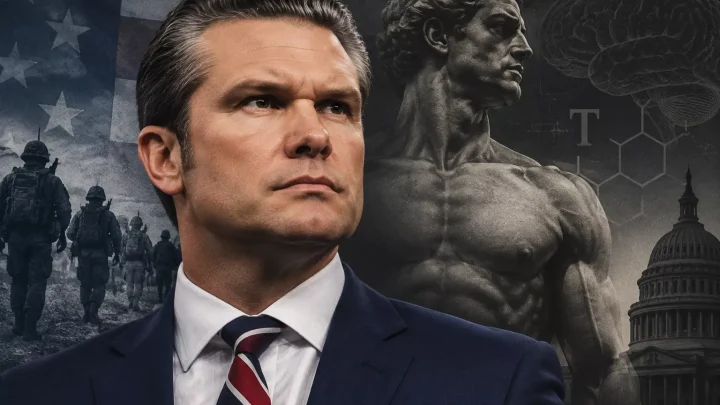
In brief: Defense Secretary Pete Hegseth has made toughness the theme of his Pentagon, from yearly testosterone tests for troops 30 and older to a September 30 speech promising “patriotic cowboys” and “no fatties, no trannies, no beardos.” Psychology research on “precarious manhood” helps explain why this message appeals to many people and why it can backfire. When an institution rewards looking strong, it can lose sight of being ready, and critics say that is what is happening now.
What has Hegseth said and done?
In July, Mr. Hegseth ordered testosterone screening for active-duty service members aged 30 and older, added to the annual health assessment; younger troops can ask for it, and treatment is optional. He said the program is “not about artificial enhancement” but about “restoring and optimizing your natural capabilities,” and branded it “The High-T Department of War.” Doctors are split. Major medical groups do not recommend routine screening for men without symptoms, and Dr. Martin Miner of Brown University called the plan “very aggressive.” Dr. Mohit Khera of Baylor College of Medicine called it reasonable, since low testosterone can cause fatigue, muscle loss and depression.
On September 30, at Marine Corps Base Quantico, he gave a “State of the Force” address, which he said will become annual, to hundreds of junior officers and enlisted leaders. “The patriotic cowboys are in, with testosterone testing on top,” he said, and: “No fatties, no trannies, no beardos, no weirdos, no wimps, no radicals. Just warriors.” He called press coverage of the Iran war “treason, actually,” and announced a project on the future of warfare led by Elon Musk, Palmer Luckey and Newt Gingrich.
In a Foreign Policy column titled “Why Hegseth Should Go,” Christian Caryl argues that the defense secretary “puts stunts over substance.” He points to what happened days later: the U.S. pulled its B-1 bombers out of Britain’s RAF Fairford after intelligence about a possible Iranian drone attack, first reported by The Wall Street Journal.
What is “precarious manhood”?
Psychologists Joseph Vandello and Jennifer Bosson of the University of South Florida describe manhood as “hard won and easily lost.” Unlike womanhood, which people tend to see as a matter of biology, manhood is treated as a status a man has to earn and keep proving. When that status feels threatened, many men try to restore it by showing strength.
Their experiments make the point vividly. Men who were asked to braid hair, a task they saw as feminine, overwhelmingly chose to hit a punching bag afterward rather than do a puzzle, and they punched harder than other men. Bosson also found that other men, not women, are the main enforcers of these rules.
Why does threatened masculinity turn into toughness?
Sociologist Robb Willer and colleagues tested this directly. In experiments published in 2013 in the American Journal of Sociology, researchers randomly told men that a survey showed they had a “feminine” identity. Compared with men told they were masculine, those men expressed more support for the Iraq War and for one group dominating others. Women’s views did not change. The researchers called it “overcompensation.”
The “High-T” message is ironic. In one of Willer’s studies, men with higher natural testosterone reacted more strongly to the threat. The hormone does not make men tougher in any simple sense; it can make them more sensitive to feeling challenged.
Performance is aimed at an audience. Hegseth spent years as a Fox News host, and a Reuters analysis on October 16 called his “TV instincts” one of the tools he relies on most. Insults like “beardos” and “wimps” are built for clips. They tell the audience who belongs and who does not.
Why does the message appeal to supporters?
Many supporters hear none of this as insecurity. They see a leader who believes the military grew soft, distracted by politics and paperwork, and who is restoring standards and a fighting spirit. For a young person deciding whether to enlist, or a veteran who felt the old culture slipping away, “just warriors” can sound like respect.
That fits the larger appeal of Mr. Trump, who governs as an authoritarian, or at least leans that way, and has given Hegseth wide latitude; Hegseth says the Pentagon has fired about 10% of its generals and admirals. To his base, he projects strength, and so does his defense secretary. For them, the belief is the reality.
What does performed toughness cost?
It can hide real problems. The aircraft carrier USS Abraham Lincoln has been deployed since November. Families and some outlets reported food shortages, poor conditions, and falling morale; the Navy denies most of it, and Mr. Hegseth called the reports “completely misrepresented.” When a culture rewards strength, admitting strain can feel like weakness, so problems go unreported until they are hard to ignore.
It confuses image with readiness. Drones, logistics and alliances win modern wars. Caryl argues that the Quantico speech said little about strategy or allies, even as the U.S. moved bombers to keep them out of drone range.
Spectacle can backfire. Hegseth’s plan to livestream the execution of Fort Hood shooter Nidal Hasan was meant to show “serious consequences.” Instead, as we wrote about why 8 in 10 Americans rejected it, it drew bipartisan disgust, and Mr. Trump canceled it.
Contempt shapes who hears it. Mocking groups of troops tells everyone in uniform that their place depends on fitting an image. Research on bullying shows that contempt from those in charge permits others to pile on.
What comes next?
Rep. Thomas Massie, a Republican, filed articles of impeachment on September 15, accusing Mr. Hegseth of abusing his powers in the Iran war. Speaker Mike Johnson called it a “publicity stunt” and sent the House home early for the campaign, pushing any vote past the election. The measure is not expected to pass, though Democrats could pursue it if they win the House on November 3.
Toughness has a real place in a military. The question psychology raises is whether it is being built or performed. Strength that has to announce itself, again and again, often says more about a leader’s need to be seen as strong than about the force he leads.
Related commentary
- Why 8 in 10 Americans Rejected a Livestreamed Execution
- The Iran War and the American Psyche
- Trump Follower Psychology 101
- Signs of Bullying
Sources
- Why Hegseth Should Go — Christian Caryl, Foreign Policy (October 14, 2026)
- Hegseth announces plan to screen military members’ testosterone levels — NPR via HPPR (July 16, 2026)
- Leaning into culture war flashpoints, Hegseth says he has transformed U.S. military — NPR via AllSides
- Hegseth’s Quantico “State of the Force” speech — The Daily Beast
- U.S. reportedly removed bombers from British airbase over potential Iran drone attack — Times of Israel (October 6, 2026)
- Think it’s easy to be macho? Psychologists show how “precarious” manhood is — Association for Psychological Science
- Willer et al., Overdoing Gender: A Test of the Masculine Overcompensation Thesis (American Journal of Sociology, 2013) — Harvard Kennedy School
- Hegseth’s TV instincts backfire as Trump rejects execution livestream — Reuters via The Star (October 16, 2026)
- USS Lincoln morale on a record deployment — Task & Purpose
- Johnson sends Congress home early, delaying Hegseth impeachment vote — KBTX/Gray News