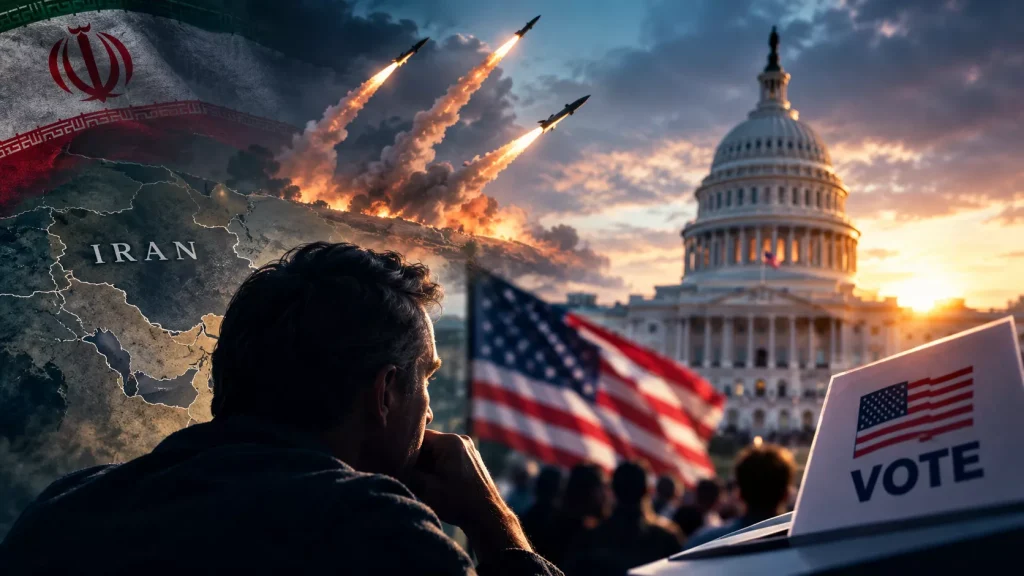
In brief: Seven months after it began on February 28, support for the Iran war has fallen to about 32%, a record low. Only 2% of Americans call it their top voting issue, yet 86% say it has hurt their cost of living. Uncertainty, an expired “rally round the flag” effect and partisan filtering explain why a distant war has become a kitchen-table issue before the midterms.
Wars usually rally a country, at least at first. The Iran war that began on February 28, when U.S. and Israeli strikes killed Supreme Leader Ali Khamenei, has followed a different emotional path. Seven months later, support for the war has fallen to about 32% in Nate Silver’s polling average, the lowest since it began. And with the midterms four weeks away, the war is shaping the American mood in a way that few foreign conflicts ever have.
How is the Iran war affecting Americans at home?
Here is the paradox. In the Chicago Council on Global Affairs’ 2026 survey, only 2% of Americans named the Iran war as their most important voting issue. Yet 86% said the war has been bad for the cost of living, 72% said it has hurt America’s reputation abroad, and 65% said it has been bad for national security.
“People are making the connection between a foreign policy issue and their personal financial well-being more than at any time I’ve seen in the last 15 years,” the Council’s Dina Smeltz told the Christian Science Monitor.
Psychologically, that makes sense. Most Americans have no direct experience of the fighting, but they experience its consequences every time they fill up the car. Gas prices rose more than a dollar a gallon after the Strait of Hormuz was disrupted. Shipping companies added fuel surcharges, airlines raised fees, and one airline shut down entirely. The war is distant; the bill is not.
Why has support for the war fallen so far?
Uncertainty is harder to bear than bad news. The human mind copes better with a known hardship than an open-ended one. In July, 55% of voters told Quinnipiac they expected the conflict to last a year or longer. Ceasefires in April and June both collapsed. When people cannot see an end point, stress becomes chronic, and chronic stress tends to come out as irritability, distrust and a desire to punish whoever is in charge.
The rally effect has expired. Political scientists call the early surge of support for a leader in wartime the “rally round the flag” effect. It is real, but it is short, and it depends on the public believing the conflict will be quick and successful. Once a war becomes a grind, the emotional framing shifts from “us against them” to “why are we still doing this?” The administration’s assurances that Iran is “ready to fold up” and that the U.S. will win “right after the election” are attempts to restart that rally. The polling suggests the public has heard similar promises before.
Partisan identity is a filter. Republicans remain much more supportive than Democrats or independents, and in a polarized country, views about a war become part of who people are. That cuts both ways. It keeps a core of support stable, but it also means the persuadable middle reads every new escalation, such as the additional carriers and troops now heading to the region, as a sign the war is getting bigger, not ending.
Will the Iran war affect the 2026 midterms?
Foreign policy rarely decides American elections. This year may be an exception, not because voters are thinking about the Middle East, but because the war has become part of the cost-of-living story that dominates every race. Candidates are not running ads about Iran; they are running ads about gas, groceries and electricity, and the war sits underneath all of it.
For the party in power, that is a difficult emotional position. Asking voters to accept short-term sacrifice requires a shared sense of purpose. Only 31% of Americans in the Chicago Council survey said the war was worth fighting. Without that shared purpose, sacrifice simply feels like loss.
What are the benefits and drawbacks of staying the course?
Supporters of the war argue it has degraded a hostile regime: three in four Americans agree it has weakened Iran’s position in the region. If it ends with a durable settlement and a stable oil supply, the president could argue that short-term pain bought long-term security, and voters may be more forgiving in hindsight than they are today.
The drawback is time. The longer the war lasts without a clear goal, the more it becomes a symbol of everything voters feel has gone wrong, and the harder it is for any argument about long-term strategy to compete with this week’s gas bill.
The lesson from the psychology is simple: people can endure a great deal when they understand why and can see an end. The Iran war, so far, has offered Americans neither.
Related commentary
- Four Weeks Out: The Midterm Map and the Psychology of a Wave
- U.S. Goals Regarding Iran After Assassination (2020)
- Iraq Crisis: How Does This Impact the Economy and Gas Prices? (2014)
Sources
- Silver Bulletin — Iran war polling average (Oct. 6, 2026)
- Chicago Council on Global Affairs — Americans, Foreign Policy, and the 2026 Midterms
- Christian Science Monitor — War and tariffs: How foreign policy is impacting the midterms (Oct. 6, 2026)
- Quinnipiac University national poll (July 29, 2026)
- CBS News — Iran war live updates
- 2026 Iran war fuel crisis (overview)