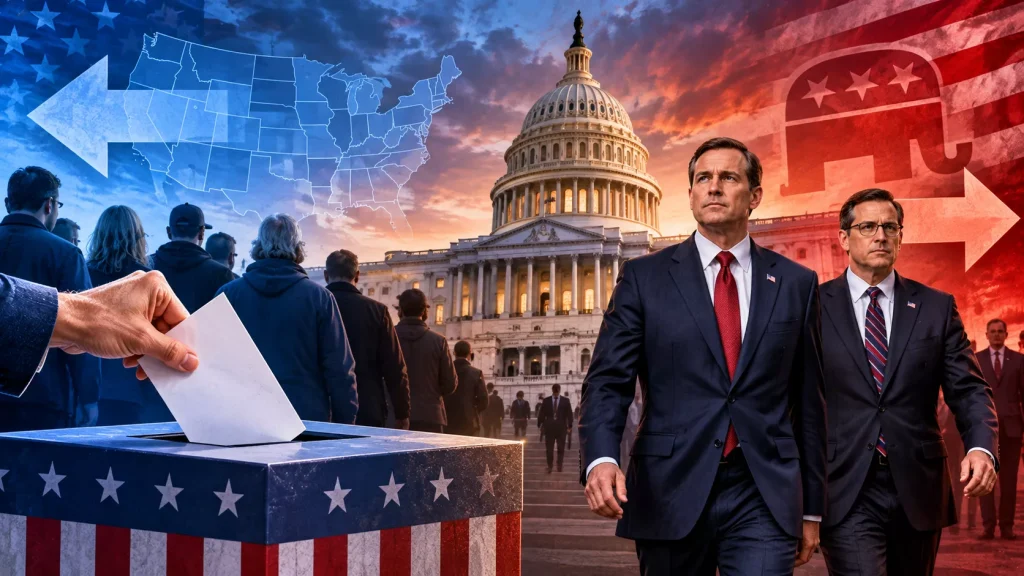
In brief: The 2026 midterms were a clear rebuke. Democrats took both chambers of Congress, and exit polls show voters turned against the cruelty, chaos, and costs of MAGA governance, including an immigration crackdown most of them said went too far. President Trump even admitted his deportation policy “might be too tough.” Yet within a week, Republicans elevated Stephen Miller, the architect of that policy, to White House chief of staff and chose Jim Jordan, the party’s most combative Trump defender, as House minority leader. Psychology offers a clear explanation for why people double down at exactly the moment they are told to change course.
In psychology, we learn early that the most honest thing a person tells you is not what they say. It is what they do. On November 3, the American electorate did something, and it was not subtle.
Democrats took both chambers of Congress. In the Senate, they flipped seven seats, including Texas, South Carolina, Kansas, Iowa, Ohio, Maine, and North Carolina, states that a year ago were barely on anyone’s map. In the House, Republicans lost more than 40 seats, and Democrats are on track for their largest majority in nearly two decades. More than 124 million ballots were cast, a midterm record. This was not a sleepy, low-turnout correction. This was a crowd showing up to say something.
And what they said, when pollsters asked them, was remarkably consistent.
What were voters telling us?
In the national exit poll, President Trump’s approval sat at 37 percent. Roughly nine in ten voters called government corruption a major factor in their vote, about the same share who cited the cost of living. Most said the war with Iran was the wrong decision. Nearly six in ten also said the administration’s immigration enforcement had gone too far.
That last number deserves attention, because immigration was supposed to be the MAGA movement’s home turf. It was the issue that carried Donald Trump back into office in 2024. Two years later, a majority of the people who actually voted looked at masked agents in American neighborhoods, tear gas on residential streets, and families pulled apart, and concluded that it was too much.
I would describe the result as a rejection of MAGA as a way of governing: the cruelty, the chaos, the sense that loyalty to one man outranks the needs of everyone else. Voters were not asking for a different slogan. They wanted a different temperament.
The President heard it. Why did he do the opposite?
Here is where the story becomes psychologically fascinating.
In his first major interview after the election, on CBS’s 60 Minutes, President Trump said something I did not expect to hear from him. Asked about his deportation campaign, he conceded, “I think it might be too tough, yeah,” and added that he thought it ultimately hurt him. This is the same President who, one year earlier on the same program, said the raids “haven’t gone far enough.”
That is a genuine moment of feedback reaching the decision-maker. In therapy, we would call it a breakthrough, the instant a person names the behavior that is costing them.
And then, the same day the interview was taped, he named Stephen Miller as his new White House chief of staff.
Miller is widely described as the architect of the mass deportation campaign the President had just called too tough. He replaces Susie Wiles, and according to reporting, his stated focus is rebuilding the fractured MAGA coalition and energizing the 2024 base. Senate Democratic Leader Chuck Schumer captured the contradiction in a single line, observing that Trump’s solution to an immigration policy he says went too far was to put the man responsible for it in charge of the White House.
Two days later, House Republicans finished the thought. On November 10, they elected Jim Jordan as their leader for the next Congress, 106 to 73, over Steve Scalise. Jordan is a founding member of the hardline Freedom Caucus and one of the President’s most combative defenders. By nearly every account, his job will be to serve as the President’s chief shield against the investigations the new Democratic majorities have promised.
So the electorate said: less extremism, less chaos, lower costs. Washington’s Republicans answered: more Miller, more Jordan, more fight.
Why do people double down when they are told they are wrong?
None of this is irrational at first glance. It is very human, and it follows patterns psychologists have studied for decades.
Escalation of commitment. When people have invested heavily in a course of action- money, reputation, identity- they often respond to failure by investing more, not less. Retreating would mean admitting the earlier investment was a mistake. Advancing lets them believe success is just one more push away. Elevating Miller and Jordan is escalation of commitment written as an org chart.
Identity-protective thinking. For a movement built on a single identity, a defeat is not processed as information about policy. It is processed as an attack on the group. And when a group feels attacked, it reaches for its fiercest defenders, not its most persuasive ambassadors. Jordan was elected precisely because he is a fighter, and fighters are what a threatened group wants, even when voters just rejected fighting.
Groupthink and the shrinking circle. Leaders under pressure tend to pull their circle tighter around people who validate them. Miller’s influence, as has been widely reported, rests on validating the President’s instincts, especially on immigration. That is comforting in a hard week. It is also the opposite of what a leader needs when the outside world has just corrected them.
The say-do gap. Most importantly, people judge us by behavior, not words. The President’s admission on 60 Minutes may well have been sincere. But voters won’t remember a sentence in an interview. They’ll remember who now runs the White House and who now leads House Republicans. When words and actions point in opposite directions, the actions win every time.
What happens next?
Political parties, like people, have two basic responses to a painful message. One is to listen, adjust, and recover. The other is to tune out the message and blame the messenger: the turnout, the media, the candidates who were not on the ballot.
The 2026 results gave the Republican Party a clear, data-rich message. The early personnel decisions suggest the party has chosen, at least for now, the second response. Tone deafness is not a lack of hearing. It is a decision about what to do with what you heard.
History is full of parties that took a beating and came back stronger, but almost always because they changed. A party that responds to rejection by elevating the very people most associated with what was rejected is not regrouping. It is reinforcing.
Voters will be watching what the new leadership does, not what it says. That, after all, is exactly how they made their decision on November 3.
Sources
- Democrats flip seven Senate seats — NBC News
- House GOP elects Jim Jordan as next leader in major shakeup after midterms — CBS News.
- House Republicans elect Jim Jordan as minority leader for the next Congress — ABC News.
- Jim Jordan wins House GOP minority leader race — Axios
- Midterm election results: three things to know — Gray DC
- Why Republicans lost — National Review
- CBS News exit poll results for the 2026 midterm elections — CBS News
- Trump says his deportation policy ‘might have been too tough’ for voters — Associated Press via WECT
- Trump says his mass deportation effort ‘was too tough’ — The Daily Wire
- Trump says ICE raids ‘haven’t gone far enough’ (2025) — CBS News
- Who is Stephen Miller, Trump’s new White House chief of staff? — Al Jazeera
- What to know about Stephen Miller — The New York Times via The Boston Globe
- Staw, B. M., Knee-Deep in the Big Muddy: A Study of Escalating Commitment to a Chosen Course of Action (Organizational Behavior and Human Performance, 1976)
- Janis, I. L., Victims of Groupthink (1972)