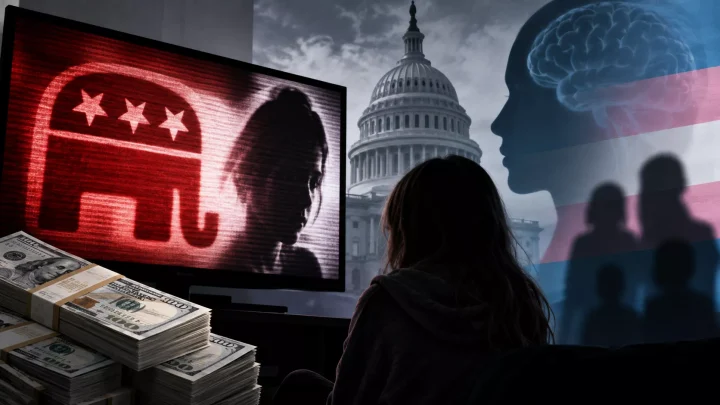

In brief: Republican groups have spent an estimated $183 million on television ads about transgender issues this cycle, more than at the same point in 2024, according to AdImpact figures reported by the Associated Press. The target is a group that makes up about one percent of Americans. The psychology of that mismatch isn’t mysterious: scapegoating, disgust, and threat are among the most reliable ways to shift attention, especially when the economy is the subject a party would rather avoid. What the ads do to voters is contested. What they do to transgender people is not.
How much are Republicans spending on anti-transgender ads?
Through October 25, Republican groups had spent about $183 million on transgender-themed TV ads, aired roughly 217,000 times, compared with about $151 million at the same stage in 2024, the Associated Press reported from AdImpact tallies. Democrats have spent about $11 million on the subject, mostly to defend themselves.
The money is concentrated in a handful of Senate races. Writer and commentator Brianna Nicole Austin, who covers transgender life and politics, broke down the AdImpact figures this week: about $58 million in Texas, where Ken Paxton faces James Talarico, including one ad from a Musk-funded PAC that aired some 17,000 times; nearly $26 million against Sherrod Brown in Ohio; and millions more in Kansas, South Carolina, Iowa and Mississippi. PolitiFact has rated at least two of the ads false.
Why target a group this small?
The Williams Institute at UCLA estimates that about 2.8 million Americans aged 13 and older identify as transgender, roughly one percent. Few voters have ever been harmed by a transgender person; many have never knowingly met one. From a persuasion standpoint, that is not a weakness of the strategy. It is the point.
Psychologists have long described scapegoating as the redirection of frustration onto a group that is visible, distinct, and relatively powerless. When people feel anxious about forces they cannot control, such as prices, jobs or a changing culture, a concrete villain is psychologically easier to hold than an abstract problem. Ms. Austin puts the pattern bluntly: the party, she writes, reaches for “the boogeyman of the hour,” and she calls the fixation on transgender athletes “a solution in search of a problem.” She argues that the goal is to keep the base enraged so that voters “lose focus” on how the party has governed.
One need not share her politics to recognize the mechanism. Sociologists call it a moral panic: a small group is cast as a threat to the majority’s values and safety, and the alarm’s size bears little relation to the actual risk.
Why do these ads work on some voters?
Three ingredients do most of the work. The first is threat, particularly threat to children. Ads that center locker rooms, school sports, and young people activate protective instincts, among the strongest motivations human beings have. The second is disgust. Research by Yoel Inbar, David Pizarro and Paul Bloom found that people who are more easily disgusted tend to hold more conservative views on sexual and moral questions, and messages that evoke bodily discomfort can bypass deliberate reasoning altogether. The third is repetition. A message seen dozens of times during a football broadcast becomes familiar, and familiarity is easily mistaken for truth.
There is also a subtler effect. Republican pollster Chris Wilson told the AP that voters may treat a candidate’s position on the issue as a proxy for broader values and judgment. In psychological terms, the ad is not really about transgender people at all; it is a shortcut that asks voters whether a candidate is “one of us.”
Do the ads actually change votes?
The evidence is genuinely mixed. An October AP-NORC poll found about 1 in 10 registered voters call transgender issues one of the most important in the election, while roughly 8 in 10 cite the economy or the cost of living. A Fox News poll in April found voters trusted Democrats over Republicans on transgender issues by 13 points. Political scientists quoted by PolitiFact say the ads may mobilize people at the margins without persuading many, and one Kansas researcher found the messaging less effective in the 2025 governors’ races.
Supporters of the strategy point to 2024, when groups such as the American Principles Project argued the ads moved swing voters toward Mr. Trump, and to polling that shows some of the underlying positions are popular: Gallup found 69 percent of adults say transgender athletes should compete on teams matching their birth sex, and Pew found 56 percent support restricting transition-related medical care for minors. The Republican National Committee says Democrats are defending procedures for children and allowing boys into girls’ sports. Those are policy arguments that deserve a fair hearing. But a 30-second attack ad, repeated 217,000 times, isn’t designed to provide a fair hearing.
What does a campaign like this do to transgender people?
Here the research is far less ambiguous. Psychologist Ilan Meyer’s minority stress model explains how stigma, rejection, and the constant expectation of hostility wear on mental and physical health over time. A campaign season spent watching your existence used as an attack line is a concentrated dose of exactly that stress. In the Trevor Project’s 2024 national survey, 90 percent of LGBTQ+ young people said recent politics had harmed their well-being, and 45 percent of transgender and nonbinary youth said they had considered moving to another state because of LGBTQ-related laws.
Those numbers describe teenagers, and the parents trying to raise them, who have no part in a Senate race but still absorb its messaging. As a psychologist, I would ask any campaign to weigh that cost against whatever it hopes to gain.
What actually reduces this kind of fear?
Contact. Decades of research on prejudice show that fear of an unfamiliar group falls when people come to know members of it. In a well-known field experiment published in Science, David Broockman and Joshua Kalla found that a single ten-minute, non-judgmental conversation reduced anti-transgender prejudice among voters, and that the effect lasted for months. The finding is a quiet rebuke to the ad strategy: a hundred million dollars can manufacture fear of a stranger, but a conversation with an actual person can undo it.
Voters will render their verdict on the strategy on November 3. Whatever the result, the more lasting question is what a country becomes when one of its smallest minorities is made the centerpiece of its most expensive arguments.
Related commentary
- Ten Days Out: Election 2026, the Races That Will Decide It
- Nineteen Days Out: The Psychology of Why Late Races Move
- Testosterone, Toughness and Spectacle: The Psychology of Hegseth’s Pentagon
- Transgender Law Bans Transgender Athletes
Sources
- Republicans Have Spent an Estimated $183 Million on Transgender-Themed TV Ads — Brianna Nicole Austin
- Republicans emphasize transgender ads, putting cultural issues over voters’ economic anxiety — Associated Press
- New estimate: 2.8 million people aged 13 and older identify as transgender in the US — Williams Institute, UCLA
- Inbar, Pizarro & Bloom, Conservatives are more easily disgusted than liberals (Cognition & Emotion, 2009)
- Meyer, Prejudice, Social Stress, and Mental Health in LGB Populations (Psychological Bulletin, 2003)
- 2024 U.S. National Survey on the Mental Health of LGBTQ+ Young People — The Trevor Project
- Broockman & Kalla, Durably reducing transphobia: A field experiment on door-to-door canvassing (Science, 2016)