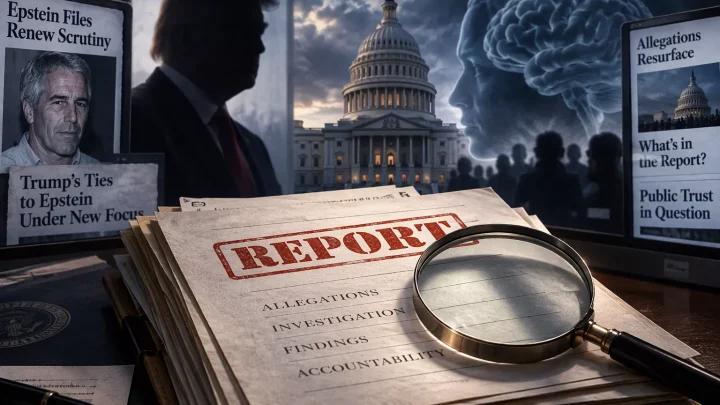
In brief: Six days before the midterms, Democrats on the House Judiciary Committee released a report of roughly 50 pages alleging that the Justice Department buried evidence from women who say Donald Trump sexually assaulted them in Jeffrey Epstein’s company, and asking for an independent special counsel. The White House says none of it is true. No allegations have been tested in court. The psychological questions are older than this report: why survivors of powerful men so often wait decades to speak, why partisans on both sides tend to hear what they already believe, and why half-released files breed more suspicion than either full disclosure or silence.
What does the new report say?
The report, released Monday, October 26 by the committee’s Democrats under Ranking Member Jamie Raskin, draws on interviews with women, FBI records and documents made public under the Epstein Files Transparency Act, Spectrum News reported. It says five women have accused Mr. Trump of rape or sexual assault in Epstein’s presence or physical company during the 1990s, and that six others described efforts by Epstein or Ghislaine Maxwell to traffic them to him.
Its most prominent new account comes from Beatrice Keul, a former Swiss pageant contestant, who told committee staff that Mr. Trump raped her at the Plaza Hotel in November 1993. The report also names Paolo Zampolli, a former modeling agent and until this month a U.S. special envoy, as a possible co-conspirator alongside Mr. Trump, and it accuses Attorney General Todd Blanche of telling Maxwell not to discuss a survivor whose account implicates the president.
The broader charge is institutional. The Democrats argue that the Justice Department closed investigations into Epstein’s possible accomplices too early and, under the transparency law, released a heavily redacted and incomplete record. According to the Associated Press, the department has made about 3.5 million files public while withholding roughly 40 percent of what the government holds. Committee Republicans did not endorse the report.
How have the White House and the Justice Department responded?
With flat denials. White House spokeswoman Lauren Bis said none of the allegations are true and called the report a desperate attempt to distract from Republican momentum. A Justice Department spokeswoman called it a last-ditch effort to mislead the public, said the department complied with the transparency law, and pointed to the government’s prosecutions of Epstein and Maxwell. Mr. Trump has long denied knowing about Epstein’s abuse of minors or taking part in his crimes.
That leaves the public with two irreconcilable accounts a week before an election, and no neutral body yet empowered to sort them out. That is precisely when human judgment is least reliable.
Why do survivors often wait decades to come forward?
The first instinct many people have when an accusation surfaces 30 years later is to ask, “Why now?” It is a reasonable question, and it deserves an answer grounded in what psychologists actually know about sexual violence rather than in partisan reflex.
Delayed disclosure is the norm, not the exception, among survivors of sexual assault, especially when the offender is powerful, well connected, or able to retaliate. Shame, self-blame, fear of not being believed, and fear of consequences keep people silent. Psychologists Carly Parnitzke Smith and Jennifer Freyd describe a further injury they call institutional betrayal: when the organizations that should protect victims instead dismiss or shield the accused, survivors learn that speaking up costs more than staying quiet. Many come forward only when the ground shifts, when other accusers speak, when a law opens records, or when a public body finally asks.
Honesty requires the other half of the picture, too. Time erodes evidence, memories can be contested, and accounts given decades later are harder to corroborate. Delay does not make an allegation false, and it does not make it true. It makes careful, independent investigation more important, not less.
Why won’t this report change many minds?
Because people process damaging information about their own side differently than they process it about the other. Psychologist Ziva Kunda’s classic work on motivated reasoning showed that we hold evidence we dislike to a higher standard than evidence we welcome. When a leader becomes part of a person’s identity, an accusation against him feels like an accusation against the person and their community, and the mind defends accordingly.
Timing adds a second filter. A report released days before an election invites the “October surprise” reading, and that suspicion is not irrational: political actors do time their disclosures. Supporters will discount the report for its timing; opponents will treat it as confirmation of what they already believed. As I wrote earlier this month in Guilt by Association, Mr. Trump’s long association with Epstein has been public for years and has moved remarkably few voters. The people most likely to be affected now are the genuinely undecided, and the women in both parties who weigh these questions most heavily.
What does a partial release do to public trust?
Secrecy rarely ends suspicion; it relocates it. When Congress passed and the president signed a law to release the Epstein files, the public was promised an ending. A visibly incomplete release gives people a new mystery: what is in the part we cannot see? Research on conspiracy belief consistently links it to feelings of powerlessness and distrust of institutions, and few things deepen distrust more than the sense that the powerful are protected by rules that don’t apply to anyone else.
This cuts in every direction. If the withheld material contains nothing damaging, its release would deflate the accusations. If it does, the public has a right to know. In either case, continued concealment is the one outcome that guarantees the suspicion will outlive the election.
What would actually settle it?
Not a report from one party, and not a denial from a press office. The mechanism the Democrats are asking for, an independent special counsel with access to the full record, exists precisely for situations in which the government is investigating people at the top of its own chain of command. Whether one believes the survivors or the president, only an independent review could produce an answer both sides would have to take seriously.
Until then, the healthiest stance psychologically is also the most demanding one: to hold the allegations as serious and unproven at the same time, to resist the pull to decide based on which team we are on, and to remember that at the center of the Epstein case are at least 1,000 women and children the Justice Department itself says he abused. Their claim on the truth does not expire with an election cycle.
Related commentary
- Guilt by Association: Do Epstein, the Tate Brothers, and the Company a Leader Keeps Erode Trust?
- “Don’t Believe Your Eyes, Believe Me”: The Psychology of Trump’s Supporters
- Ten Days Out: Election 2026 and the Races That Will Decide It
- “Leakers Should Be Shot”: The Psychology of Intimidation
Sources
- House Democrats say DOJ hiding Trump-Epstein assault evidence — Spectrum News
- Democrats want special counsel to probe Trump-Epstein ties — Associated Press via Lee Enterprises
- Democrats release report on Trump Epstein files cover-up — The New Republic
- House Democrats call on DOJ to name special counsel in Epstein case — NBC News
- Smith & Freyd, Institutional Betrayal (American Psychologist, 2014)
- Kunda, The Case for Motivated Reasoning (Psychological Bulletin, 1990)