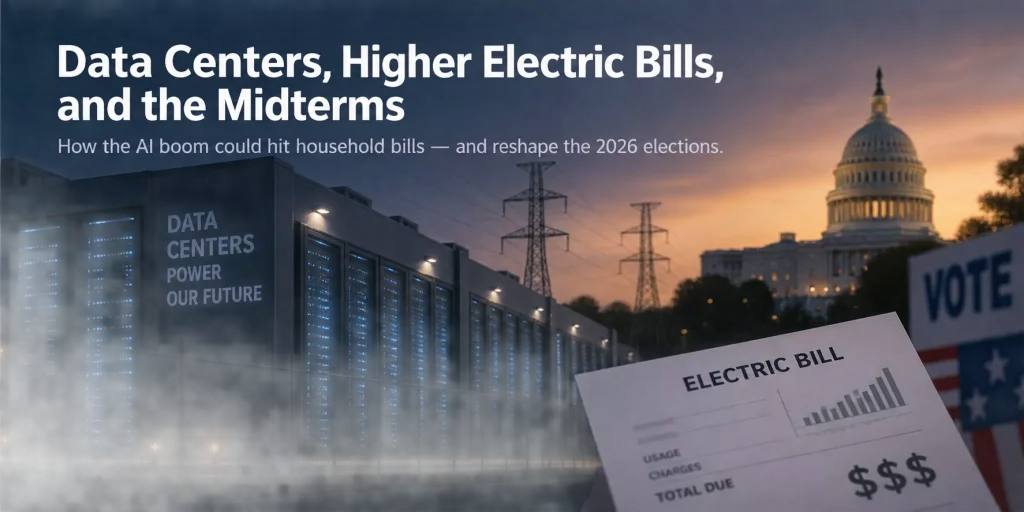
In brief: In about a year, Americans went from evenly split on data centers to 64% saying their rapid construction is “not a good thing,” and 77% fear higher electric bills. Concrete local costs beat abstract national benefits, fear of AI attaches to a visible building, and a sense of unfairness drives the backlash that has turned data centers into a midterm issue.
A year ago, data centers were a story for the business pages. In the 2026 midterms, they have become a campaign issue in places as different as Ohio, Texas and Pennsylvania. And the shift says as much about human psychology as it does about technology.
How quickly did Americans turn against data centers?
In September 2025, Americans were evenly split on building more data centers: 44% in favor, 42% opposed. By June 2026, a Reuters/Ipsos poll found 64% saying the rapid construction of data centers is “not a good thing.” Seventy-seven percent worry data centers will raise their electricity rates, and only 14% say they would be willing to live near one, according to a Brookings Institution analysis.
Politicians noticed. In one of the year’s closest Senate races, Ohio, Sherrod Brown is running ads calling Sen. Jon Husted the “face of data centers.” In Texas, the Democratic candidate for governor is attacking Greg Abbott as too friendly to the industry. In Pennsylvania, Gov. Josh Shapiro has moved from welcoming data centers to restricting them.
In Washington, the House passed the Ratepayer Protection Act 417–3, a bill to have state regulators consider making large power users pay for the grid upgrades built for them. On September 29 it failed in the Senate, 57–43, short of the 60 votes needed; Senate Democratic leader Chuck Schumer called it “toothless” because it was optional. Days later, President Trump announced a “Super Intelligence Force” to make sure America leads the world in AI, with its charter warning against “overregulation.”
Why is the backlash against data centers so emotional?
Abstract benefits, concrete costs. The promised benefits of AI are large but vague: national competitiveness, economic growth, future breakthroughs. The costs are specific and local: a higher electric bill, a huge building down the road, worries about water. Psychologically, concrete and immediate always beats abstract and distant. People discount future rewards and feel present costs sharply.
Fear of the unknown. New technology often triggers a familiar pattern: excitement at the top, anxiety at the bottom. Many Americans already feel uneasy about what AI will mean for their jobs and their children. A data center is a physical symbol of that uncertainty, a place to point to when people feel change is being done to them rather than with them.
Fairness. The sharpest emotion in the data center fight is not fear but a sense of unfairness: the belief that some of the world’s richest companies are getting cheap power while ordinary households pick up the tab. People will accept a lot of change if they believe the costs are shared fairly. They resist fiercely when they believe they are being asked to subsidize someone else’s profit.
What are the benefits and drawbacks of building more data centers?
There is a real case for building. Data centers bring construction jobs and tax revenue, and the president argued in Ohio that if America does not build them, “they’ll go to China.” Leaders in both parties worry about falling behind in a technology with major economic and security implications.
The drawback is trust. When the public believes the benefits flow to a few and the costs to everyone, support collapses, no matter how strong the strategic argument. That is what has happened in a little over a year.
What does the data center fight mean for politics in the age of AI?
The data center fight is a preview of politics in the age of AI. Voters are not rejecting technology; they are asking who pays and who benefits. Candidates who can answer that question in concrete, local terms will have an advantage. Those who answer with abstractions about the future will find, as many already have, that the electric bill speaks louder.
Related commentary
- Four Weeks Out: The Midterm Map and the Psychology of a Wave
- The Iran War and the American Psyche
- Trump and the American Economy (2019)