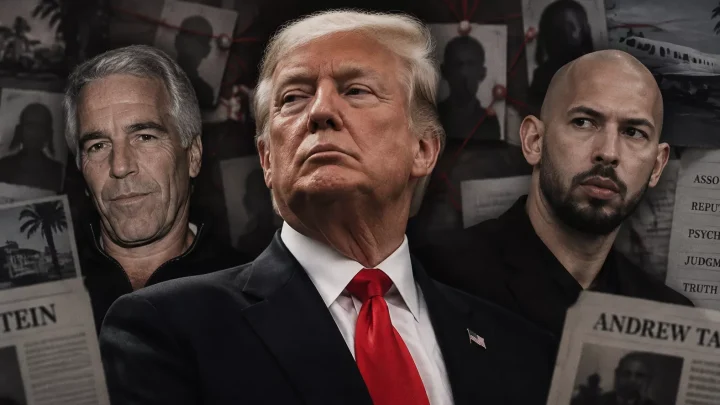
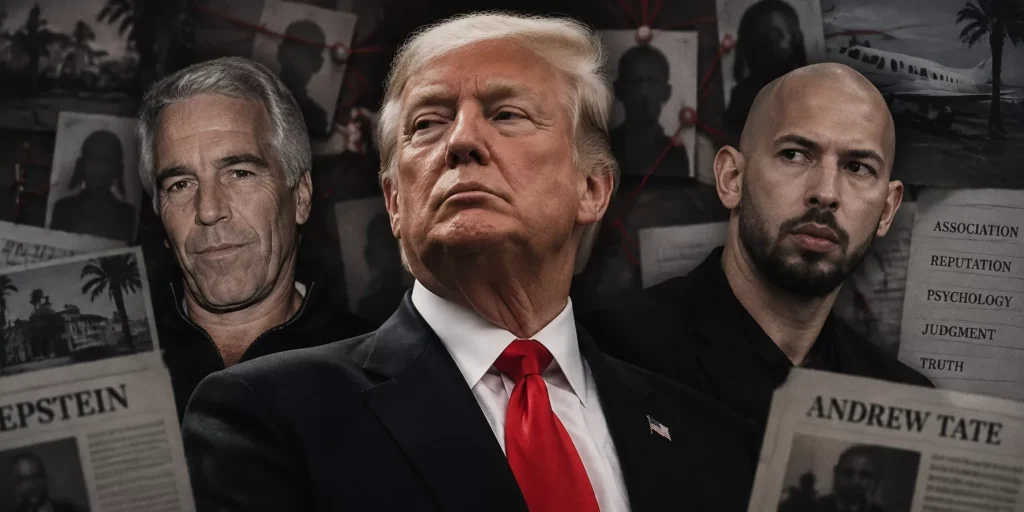
In brief: Psychology research shows people do judge others by the company they keep, but partisanship sharply limits the effect. Half of Americans believe President Trump was involved in Jeffrey Epstein’s alleged crimes, yet only 13% of Republicans agree. Associations rarely change a loyal supporter’s mind on their own; what they do is lower the ceiling of trust among everyone else, and wear on supporters slowly, one story at a time.
What are the associations?
Some facts are a matter of public record. Mr. Trump and Jeffrey Epstein moved in the same social circles in the 1990s and early 2000s; in a 2002 magazine interview, Mr. Trump called Epstein a “terrific guy” who liked “beautiful women as much as I do, and many of them are on the younger side.” The two later had a falling-out, and Mr. Trump has not been charged with any crime connected to Epstein and denies any wrongdoing. Epstein’s circle included Jean-Luc Brunel, a modeling agent Epstein financed, who was charged in France with the rape of minors and died in jail in 2022 before trial.
The administration’s ties to Andrew and Tristan Tate are more recent. The New York Times has reported that Donald Trump Jr. has defended the brothers since 2017 and that Barron Trump spoke with Andrew Tate by video in 2024. After special envoy Richard Grenell raised the brothers’ case with Romanian officials in February 2025, Romania lifted their travel restrictions, a decision Romanian reporting tied to a desire to appease the new administration. The White House says it has no involvement in the Tates’ legal cases. The brothers have since been charged in Britain with rape and indicted in Romania for trafficking minors; they deny all allegations.
Then there are the allegations against Mr. Trump himself. More than two dozen women have publicly accused him of sexual misconduct, ranging from unwanted groping to rape; he denies all of them. In a 1990 divorce deposition, his first wife, Ivana, described a 1989 incident as rape, later saying she did not mean it in a literal or criminal sense. In 2023, a federal jury found Mr. Trump liable for sexually abusing and defaming the writer E. Jean Carroll and awarded her $5 million; in June 2026, the Supreme Court declined to hear his appeal. A separate $83 million defamation verdict is still on appeal.
Do people judge us by the company we keep?
Yes, and often without realizing it. Psychologists have documented a “spillover” effect in which traits associated with one person bleed onto another who appears with them. In one line of research, people who hear a speaker describe someone else’s bad behavior end up rating the speaker less favorably too. Our minds store people in networks, and bad associations travel along the links.
Trust works the same way. A leader’s choice of friends is read as a signal of his values and judgment. “Show me your friends and I’ll tell you who you are” is folk wisdom because it matches how people actually reason.
Then why doesn’t it change more minds?
Partisanship acts as a firewall. In the Economist/YouGov poll this February, 86% of Democrats and 51% of independents said Mr. Trump was involved in Epstein’s alleged crimes, compared with 13% of Republicans. The same associations that confirm critics’ worst fears are dismissed by supporters as smears.
Discounting the source. When allegations come from people or outlets supporters already distrust, they are discounted before they are considered. Mr. Trump has trained his base to hear accusations as evidence of persecution, which can turn each new story into a reason to rally around him.
Familiarity breeds numbness. Allegations that have been in the news for years lose their emotional force. Psychologists call this habituation: the tenth disturbing story produces less reaction than the first, even if it is more serious.
Why doesn’t the image crack?
Part of the answer is the image itself. Years ago, this site observed that while many supporters recognized Mr. Trump did not embody their moral values, they saw him as authentic and unafraid to say what he was thinking. Mr. Trump governs as an authoritarian, or at least leans that way, from turning federal agencies against critics to pardoning allies en masse. Yet many supporters do not see an authoritarian at all; they see a strong, fearless, patriotic fighter. In PRRI’s May survey, 78% of Republicans called him “a strong leader,” while 59% of all Americans called him “a dangerous dictator.” He projects strength, and to people who want a fighter, unsavory company can look like proof that he operates in a tough world and refuses to apologize for it. For them, the belief is the reality, and new associations are filtered through it.
Where does it break through?
Associations hurt most when they connect to something supporters already care about. The Epstein files are the clearest example. Many in Mr. Trump’s base believed Epstein’s crimes reached powerful people and were promised the truth. When the administration called the files a “hoax” and then reversed course, the issue stopped being about Mr. Trump’s past and became about whether he was protecting the powerful. A UMass poll found that 37% of Trump voters who disapproved of his handling of the files would not vote for him again.
The Tate brothers carry a similar risk with a different audience: parents, and especially mothers, who worry about the influence of “manosphere” figures on their sons. An association that is shrugged off by a loyal base can still shape the votes of people deciding whether to trust him at all.
Benefits and drawbacks
For a politician, a base that dismisses guilt by association is a shield. It allows him to survive stories that would sink others, and supporters can rightly point out that associations are not convictions and that people in public life meet many others they cannot vouch for.
The drawback is cumulative. Each story alone may change nothing; together, they shape a reputation that is hard to undo. Among voters with no strong loyalty, the question is not whether any single allegation is proven, but whether the pattern feels like a man they can trust. Fairly or not, the company a leader keeps becomes part of the answer.
Related commentary
- Don’t Believe Your Eyes, Believe Me: The Psychology of Trump’s Supporters
- The Impact of Sexual Misconduct (2017)
- Stormy Daniels Scandal (2018)
Sources
- Economist/YouGov — Half of Americans think Trump was involved in Epstein’s alleged crimes (Feb. 2026)
- PBS NewsHour — Investigation into the Tate brothers and the Trump family (Dec. 11, 2025)
- Slate — Trumpworld and the Tate brothers (Sept. 2026)
- Supreme Court rejects Trump appeal in E. Jean Carroll case (June 29, 2026)
- Fortune — Trump voter remorse and the Epstein files (May 16, 2026)
- Al Jazeera — How Trump shifted on releasing the Epstein files
- Newsweek — PRRI poll: “dangerous dictator” vs. “strong leader” (May 2026)