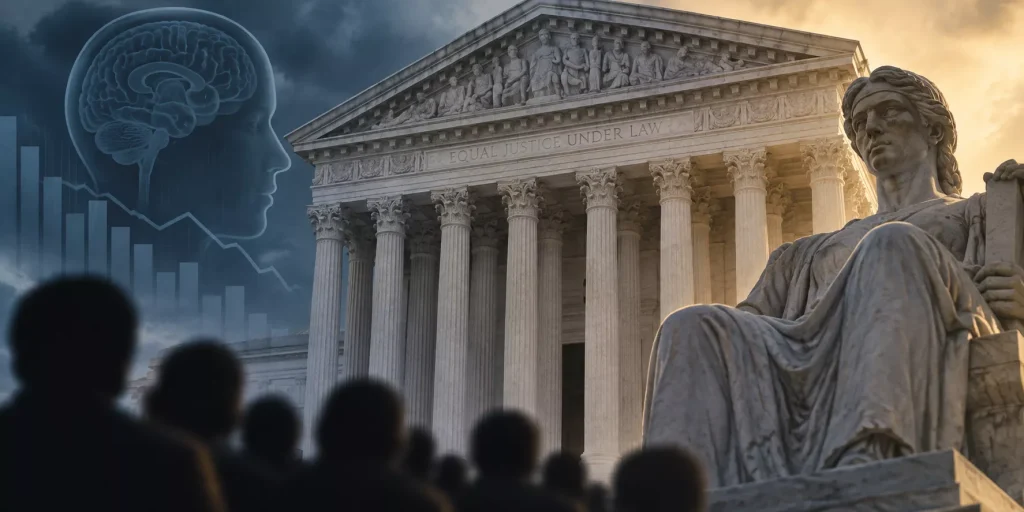
In brief: The Supreme Court opened its new term on October 5 with 43% of Americans approving of its work, down from 47% in July. Most Americans now believe the justices decide cases mainly on politics. The psychology of trust explains why the Court’s standing keeps falling no matter which way it rules.
Where does public trust in the Court stand?
The Marquette Law School Poll, taken September 2–9, found 43% of Americans approve of the Supreme Court and 57% disapprove. The split by party is stark: 71% of Republicans approve, compared with 36% of independents and just 19% of Democrats. And 57% of Americans said the justices’ decisions are “motivated mainly by politics” rather than by the law.
That is a striking number for an institution whose authority rests almost entirely on public belief that it stands above politics. The Court has no army and no budget of its own. Its power is the willingness of everyone else, including presidents, to accept its rulings.
Didn’t the Court just rule against the president?
It did, several times. In the term that ended this summer, the Court struck down the president’s executive order denying birthright citizenship, ruled that he could not use emergency powers to impose tariffs, and blocked the federalization of the National Guard in Illinois. It also handed the administration important wins: allowing ethnicity to be considered as a “relevant factor” in immigration stops, letting the president fire an FTC commissioner at will, and, on September 25, clearing the way for the government’s SAVE system to check voter rolls for noncitizens.
A court that rules against the president on his signature policies would seem to answer the charge that it is simply partisan. Yet approval fell anyway. Why?
Why do people judge a court by its outcomes?
Outcomes feel like fairness. In theory, people should judge a court by its process: did it follow the law, explain its reasoning, treat both sides fairly? In practice, most people judge by results. When a ruling matches what we want, it feels like justice; when it doesn’t, it feels like politics. Psychologists call this motivated reasoning: the mind works backward from the conclusion it prefers.
Losses are remembered longer than wins. Each side keeps a running tally of grievances. For many Democrats, the Court’s rulings on voting rights and immigration stops outweigh the tariff and birthright decisions. For some Republicans, the rulings against the president feel like betrayal by justices they helped appoint. Both sides walk away with something to resent.
Identity shapes perception. When institutions become symbols of one political team, people stop evaluating them on the merits. A Republican and a Democrat can read the same opinion and come away with opposite conclusions about the Court’s integrity. Their party, not the text, is doing the reading.
What is at stake this term?
The new term includes cases that touch deeply held beliefs: whether Colorado can exclude Catholic preschools that follow church teaching on sex and marriage from a state program, whether local bans on AR-15-style rifles violate the Second Amendment, and further challenges to the administration’s deportation and detention policies. On the opening day, the justices heard Boulder, Colorado’s climate lawsuit against oil companies, with Justice Samuel Alito recusing himself.
Each of these cases will be read through the same partisan lens. Whatever the Court decides, roughly half the country is primed to see the result as political.
Benefits and drawbacks
There is a hopeful reading. A Court that disappoints both sides at different times may be doing its job, and over the long run, consistent reasoning can rebuild trust.
The drawback is that trust is easier to lose than to rebuild. When most Americans believe the Court is political, every unpopular ruling confirms the belief, and every popular ruling is dismissed as an exception. If the public stops accepting the Court’s decisions as legitimate, the cost will not fall on one party. It will fall on the idea that disputes can be settled by law rather than by power.
The psychology lesson: people trust institutions they believe are fair to “people like me.” Restoring that belief will take more than a few surprising rulings. It will take a Court that explains itself in ways ordinary Americans can follow, and a political culture that stops treating judges as players on a team.
Related commentary
- Two Americans Dead, Nine Months Later: ICE After Minneapolis
- Analysis of Supreme Court Justice Nomination (2018)
- Chief Justice Roberts and Trump Impeachment (2020)
Sources
- Marquette Law School Poll — Supreme Court approval declines from 47% to 43% (Sept. 17, 2026)
- States United Democracy Center — What the 2025–2026 Supreme Court rulings mean for democracy
- Votebeat — Supreme Court rules in favor of Trump’s SAVE system (Sept. 25, 2026)
- SCOTUSblog — Opening the book on the October Term 2026
- Trenton Monitor — Religious liberty, gun and environmental cases in the new term